
Brown University program makes math fun, and lucrative
“The program really emphasized how fun, collaborative, and creative math is — it’s so much more than what you learn in the classroom," said one Mt. Hope student.
This item is available in full to subscribers.
Please log in to continue |
Register to post eventsIf you'd like to post an event to our calendar, you can create a free account by clicking here. Note that free accounts do not have access to our subscriber-only content. |
Day pass subscribers
Are you a day pass subscriber who needs to log in? Click here to continue.
Brown University program makes math fun, and lucrative
As a high school student, Abigail Siegel had a natural aptitude for math but had trouble envisioning how she might turn her interest into a career. Fast forward seven years, and today, the young professional is working in cyber security and software engineering.
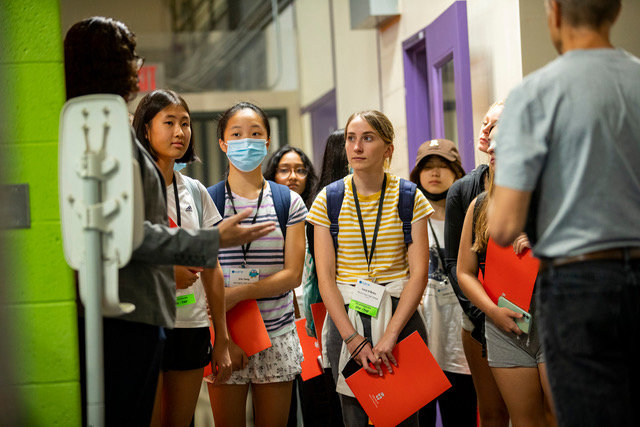
What inspired her career trajectory? She credits Girls Get Math, a mathematics program for high schoolers held at Brown University each summer. Founded and led by Brown's Institute for Computational and Experimental Research in Mathematics (ICERM), one of just six federally funded math institutes in the nation, the program’s mission is to cultivate interest, inspire confidence and instill a sense of belonging for girls exploring math and science fields.
"Girls Get Math was the first time I wrote any code," Siegel said. "I had zero exposure to computer science and knew nothing about computers, and I wouldn't have started learning about computer science when I did or at all if it wasn't for Girls Get Math."
For one summer ’22 participant, Lucy O’Brien, a Mt. Hope High School sophomore and Bristol resident, exposure to program alumnae like Siegel was one of the highlights of the week. “They shared their own journeys with math through high school, college and beyond,” she said.
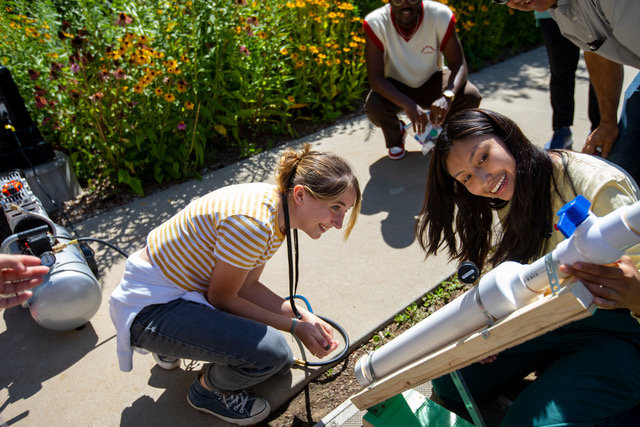
Through hands-on activities, games, interactive lectures and daily computer labs, Girls Get Math encourages students to explore mathematical topics in an open and encouraging setting. The program features a daily theme, covering topics across cryptography, data science, prime numbers, factoring and mathematical modeling. To learn about computer imaging, for example, students studied the math behind the image filters they use every day on Instagram.
With a focus on experimentation and computation, Girls Get Math introduces students to math concepts not often included in the traditional high school curriculum. Faculty leader Katharine Ott, who has organized the program since 2014, hopes it can demonstrate how the study of math can be exciting and fun to bolster girls' enthusiasm for math and science at the age when they often start losing interest and confidence.
"We're trying to show students a side of math that they don't get to see for a long time, and unfortunately, by then, they've already lost interest," said Ott, an associate professor of mathematics at Bates College and a member of ICERM's education advisory board. "We want to demonstrate different kinds of math — places where you can be super creative and collaborative, and where problems are open-ended. It's a 180 from what many students encounter in their math classes."
ICERM Director Brendan Hassett said the mission of Girls Get Math is to introduce a variety of career opportunities in which sophisticated mathematical ability plays a key role.
"It's important for us to be proactive in doing what we can to break down those barriers and to bring as many people into this work as possible," he said. "It has huge implications for science and technology, but math is also important to understanding data and making policy decisions. It is important to ensure everyone has access to these skills."
“It was fun to meet other girls my age who are also interested in math and computer science,” said O’Brien. “We explored how math applies to so many different subjects like business, politics, and art. A highlight of the program for me was coding in MATLAB, a programming platform that is used by engineers and scientists. We learned how to use MATLAB to design photo filters, model data, and recognize patterns in a card game, all of which have underlying math concepts.
“The program really emphasized how fun, collaborative, and creative math is — it’s so much more than what you learn in the classroom. I am excited to incorporate some of the games and concepts I’ve learned in Mt Hope’s coding club this year.”


