
The Byfield Flag is returning to Bristol
The oldest flag in the country is in town for a limited engagement at the Historical & Preservation Society
Dating to about 1690, the Nathaniel Byfield flag is the oldest surviving banner from the Colonial period — and it belongs to Bristol. Found bundled with several others in a massive flag case in the …
This item is available in full to subscribers.
Please log in to continue |
Register to post eventsIf you'd like to post an event to our calendar, you can create a free account by clicking here. Note that free accounts do not have access to our subscriber-only content. |
Day pass subscribers
Are you a day pass subscriber who needs to log in? Click here to continue.
The Byfield Flag is returning to Bristol
The oldest flag in the country is in town for a limited engagement at the Historical & Preservation Society
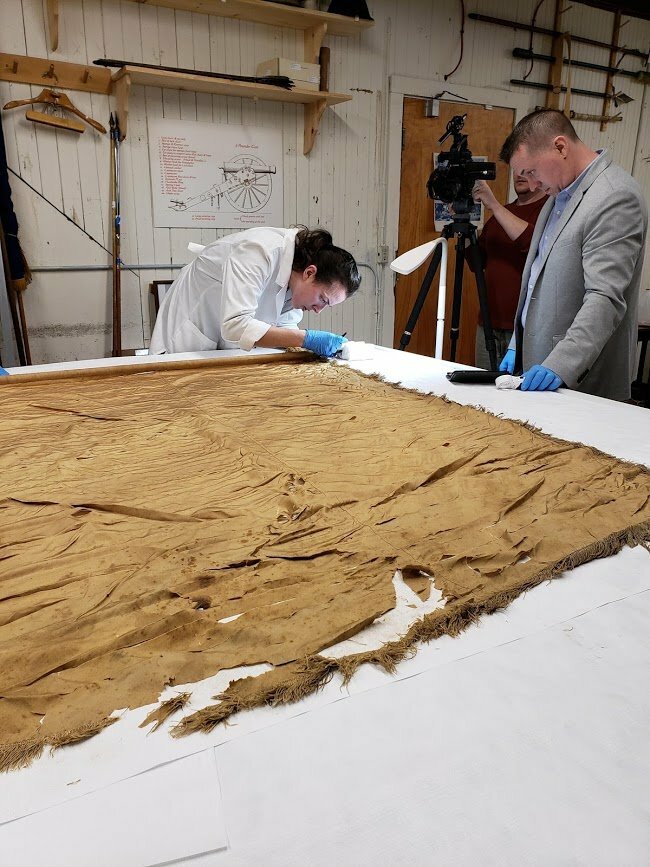
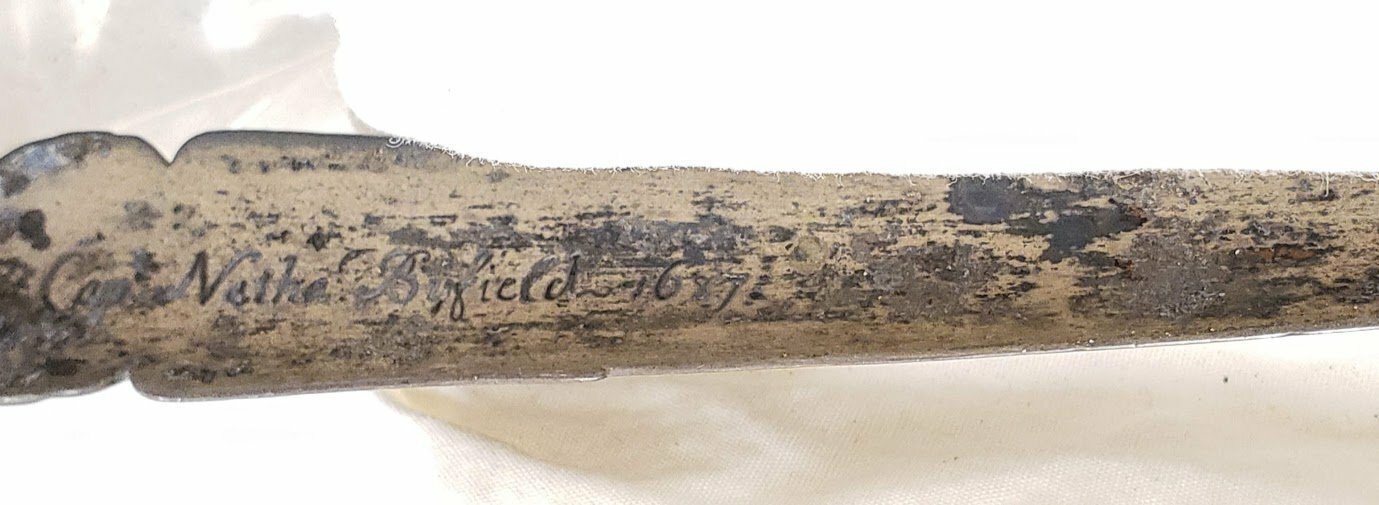
Dating to about 1690, the Nathaniel Byfield flag is the oldest surviving banner from the Colonial period — and it belongs to Bristol.
Found bundled with several others in a massive flag case in the Burnside Building on Hope Street in 2019, the flags were brought to the attention of Patrick Donovan, director of the Varnum Armory, a military museum in East Greenwich, and Maria Vazquez, an expert textile conservator.
Donovan, acting on behalf of the Varnum Armory, made a proposal to the Town of Bristol that was, after some negotiation, formalized in December 2019. They offered to investigate, conserve and display the historic flags at their East Greenwich museum.
Several of the flags were in very poor condition, their silk badly shattered or in the process of shattering, meaning the silk fabric is very brittle and breaks into pieces — even dust or powder if deterioration goes far enough.
Donovan proposed that he would project, manage, and, through the Varnum Armory, pay for the conservation of any flags deemed worthy, with close cooperation and oversight from Bristol, and the conservation work to be performed by Vazquez’ company, Royal Conservation Inc. The work would be performed at the Varnum Armory.
Given the large investment of time and money, Donovan asked the Town of Bristol to allow any of the conserved flags to be put on a long-term display at the Varnum Armory Museum, which houses the world’s largest collection of Rhode Island military history. The Town of Bristol would retain ownership, and the Varnum Armory would allow the Town of Bristol to borrow and display the flags for special events.
“When Maria and I went in 2019 and started to unfurl the flags, you could tell immediately they were 19th century. They were weighted with metal, very brittle, and we had to stop,” said Donovan.
“We brought the flags to the Armory and built a humidification chamber, and the flags spent two weeks in there. Then we spent a whole day unfurling.”
An unexpected surprise
“They were mostly Civil War flags and veterans flags,” said Donovan. “That’s still neat — but then we got to the last two — a 33-star 1861 U.S. ‘Great Star’ flag, made by ‘The Ladies of Bristol’ and presented to the 2nd volunteer regiment, the first union soldiers to engage the rebels in the first battle of Bull Run, also known as Manassas.”
Then they found the Byfield Flag, which they knew immediately was special because it still had the original finial, engraved with the date 1687.
Nathaniel Byfield was a wealthy and influential founder of Bristol and a judge and colonel in the Bristol County militia. Research uncovered a period reference to him buying a “stand of colors” (flags) for his company. The flag that emerged from the Bristol case was silk, with golden fringe, but plain. It turns out, Donovan found, that was standard for company A in the militia system — it would have been plain red silk, but now golden, though remnants of red still remain on it. What’s more, there were blood stains found on the flag, and it is believed that the flag was used in King William’s War and Queen Ann’s War, small but violent wars fought between Britain and France but with the engagement of colonists and indigenous fighters.
Conserving history
The hard work of stabilizing these flags went to Vazquez. “I’ve never worked with an object that old before, so I called Fonda Thomsen,” she said. Thomsen, who had recently retired, was responsible for the conservation of the 1813 Star-Spangled Banner. “I called her and told her I thought it might be the oldest colonial American flag and we talked do’s and don’ts for two hours. Armed with that I felt more confident.”
One thing that was different about the Byfield flag was also what actually made it easier to conserve. The silk in that flag isn’t weighted. Beginning in the 19th century, metal was added to silk to make it both stiffer and swishier.
“It gives silk a nice weight,” said Vazquez. “But it’s really detrimental for long-term conservation, and very old weighted silk flags tend to shatter, so in the bunch the Byfield flag was the only one that was not falling apart.” That, plus the dated finial, suggested it was older.
“I began trying to flatten it, starting in one corner by humidifying it with blotter paper while sandwiching it … basically a slow, careful, cold press.” She had silk crepeline dyed in the same color as the flag at the URI textile lab, stitched the flag down and combed fringe. In total, she spent 15 hours just combing fringe, and 60 to 70 hours total on the Byfield flag.
In good hands
The Byfield Flag spends most of its days safely ensconced in its darkened, flat, and climate-controlled case at the Varnum Armory, alongside other important pieces of Rhode Island’s military history.
But this week, in honor of RI250, it will be at the BH&PS, free and open to the public, and they will be open extra hours so people can come and see it.
“We hope everyone will stop by to see this remarkable piece of Bristol's past,” said BH&PS Director Catherine W. Zipf. “This flag is an important part of Bristol’s history and the story of its survival is equally remarkable. We are thrilled to welcome the flag back to Bristol and to offer Bristol residents the opportunity to see it up close and in person.”


