
Still answering the call to teach
For Virginia Davis, teaching was never simply a career — it became a lifelong calling rooted in culture and connection
For most teachers, retirement marks the end of a career. For Virginia Davis, it simply became another chapter.
After decades spent teaching Portuguese and Spanish across the East Bay, the …
This item is available in full to subscribers.
Please log in to continue |
Register to post eventsIf you'd like to post an event to our calendar, you can create a free account by clicking here. Note that free accounts do not have access to our subscriber-only content. |
Day pass subscribers
Are you a day pass subscriber who needs to log in? Click here to continue.
Still answering the call to teach
For Virginia Davis, teaching was never simply a career — it became a lifelong calling rooted in culture and connection

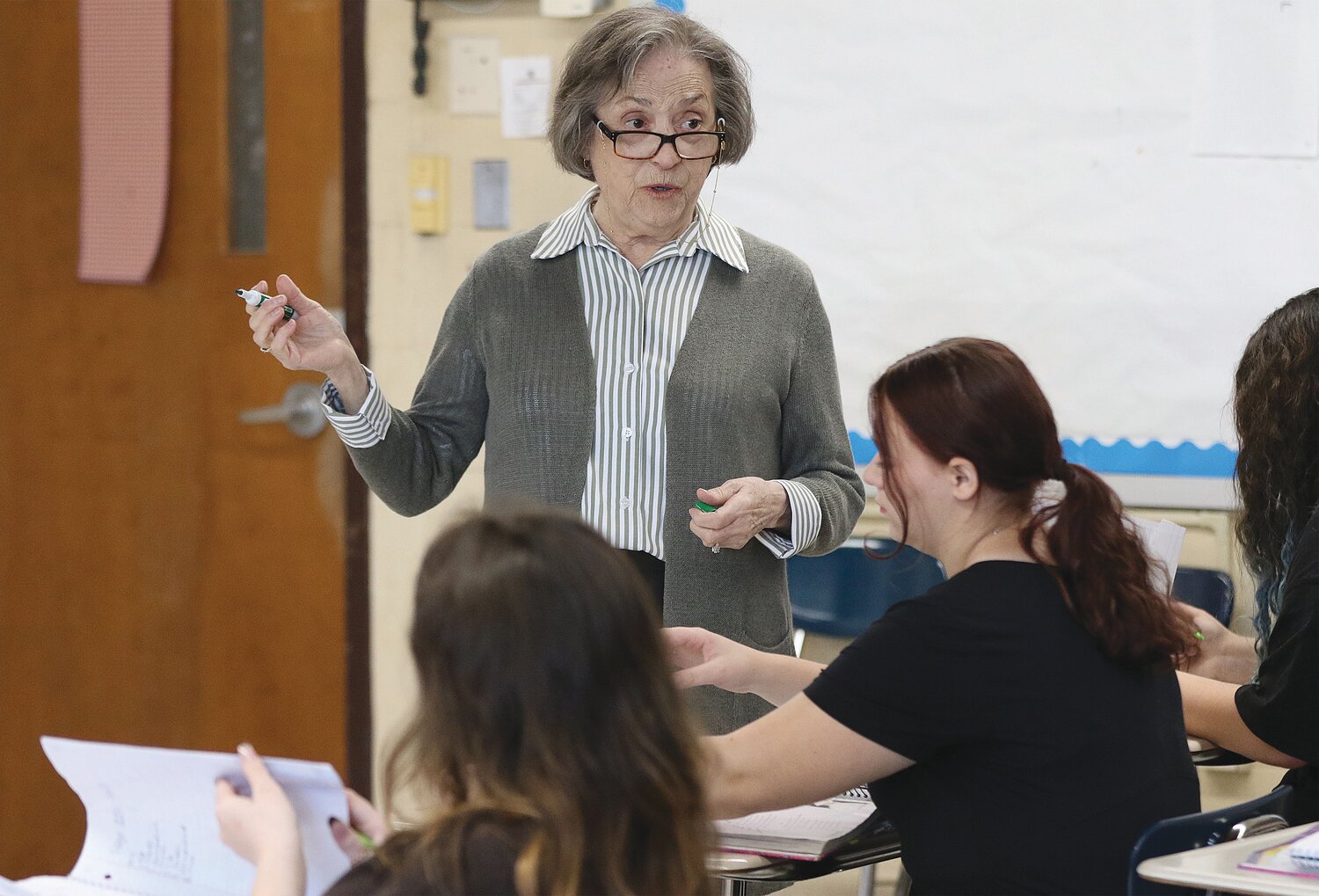


For most teachers, retirement marks the end of a career. For Virginia Davis, it simply became another chapter.
After decades spent teaching Portuguese and Spanish across the East Bay, the longtime Bristol educator recently found herself back in the classroom once again, rediscovering just how deeply teaching remains tied to her sense of purpose.
“She literally says, ‘I just love teaching. I missed it,’ ” her daughter, Maria Davis, shared during a recent interview.
Maria understands that feeling firsthand. A teacher herself for nearly 30 years, she says watching her mother return to the classroom has only reinforced how deeply teaching can shape a person’s identity and sense of fulfillment.
Now serving as a long-term substitute at Mt. Hope High School, Davis has stepped back into a role she first began nearly 60 years ago. A graduate of what was then Bristol High School, she started teaching at just 21 years old, eventually spending 28 years there before continuing her career at Bayview and other schools throughout the region.
Even after officially retiring, she never stayed away from education for long.
“She’s like Michael Jordan,” Maria joked. “She just keeps coming back.”
Behind the humor is a deeper truth: for Davis, teaching was never simply a profession. It was a lifelong passion rooted in language, culture, and connection.
“I think I was pre-selected by destiny to be a teacher,” Davis said during a separate interview. “I always, always loved my job and counted it as being one of the very lucky people in life who was doing what he or she actually enjoyed.”
For Davis, that love began early.
“When the kids would get together in the neighborhood, I would say, ‘Let’s play school if I can be the teacher,’ ” she recalled with a laugh.
Born in São Miguel in the Azores before immigrating to the United States as an infant, Davis grew up in a Portuguese-speaking household deeply connected to the local Azorean community. Over the years, that heritage became central to both her teaching and her life outside the classroom.
In addition to teaching Portuguese and Spanish in local schools, Davis also taught Portuguese classes at St. Elizabeth School and Rogers Free Library in Bristol. During summers, she worked as a Portuguese and Spanish interpreter at Rhode Island Hospital.
“She’s just a linguist,” Maria said. “Even in her spare time, she learned Russian and Italian.”
Davis originally studied English in college with a minor in Spanish, but her path shifted when schools struggled to find Portuguese teachers.
“They needed someone who could teach Portuguese,” Davis explained. “Eventually, I took the 36 credits to get full certification in Portuguese and wound up teaching Portuguese and Spanish my whole life.”
Her love of language extended well beyond vocabulary lessons.
“It’s not just about grammar,” Maria explained. “It’s about living the language.”
It’s communication and culture
Davis emphasized culture as much as communication, introducing students to music, traditions, food, and relationships within Portuguese- and Spanish-speaking communities.
“That’s what I tried to tell the students,” Davis said. “The music, the food, the relationships with people. It’s just amazing.”
Whether through storytelling, cultural context, or hands-on activities, Davis approached teaching holistically. Recently, while helping students recover from a disrupted school year, she created a simple classroom exercise involving balloons. Students tossed them back and forth while naming colors in Spanish or Portuguese, transforming memorization into movement, interaction, and play.
“She genuinely cares,” Maria said.
That care, she noted, often extends beyond academics. Though currently working as a substitute, Davis still checks in on struggling students and reaches out to guidance counselors when she notices a child may need support.
“She doesn’t need to do that,” Maria said. “But she does.”
The joy of teaching
For Davis, a successful classroom has always been about more than test scores.
“When you have a class that’s with you, so to speak, they cooperate with you and they follow along, and you have that moment when all of them get the message,” she said.
Emotionally, she described students as “gems waiting to be finalized,” praising their willingness to listen, grow, and learn.
Over the years, generations of students have come to know Davis not only as a teacher, but as a lasting presence in the community. Today, former students — and increasingly, their children — continue to recognize her in school hallways and around town.
“She’ll come home and say somebody stopped her and asked, ‘Are you Mrs. Davis?’ ” Maria recalled. “Then they’ll tell her, ‘My mom had you,’ or ‘My uncle had you.’ ”
Some former students went on to become language educators themselves.
“I have now a young lady who’s teaching two doors down from me, Augusta Costa, who was my student,” Davis said. “It is absolutely beautiful to see her in that room.”
Another former student continued studying Portuguese abroad and eventually became fluent.
“That is a joyous, joyous thing for a teacher like me,” she said.
For Davis, language education also became a way to strengthen cultural identity and community connection within Bristol’s Portuguese population.
Growing up, she watched Portuguese immigrant families transform small homes and tightly packed neighborhoods into vibrant spaces filled with flowers, grapevines, and carefully maintained gardens.
“They would buy little homes and make them their little castles,” Davis said.
The return to teaching also arrived during a personally difficult chapter. Following the loss of her husband a few years ago, stepping back into the classroom provided renewed energy, structure, and intellectual stimulation.
“She didn’t realize how much she missed teaching until she went back,” Maria said.
An open classroom
Now, after nearly six decades in education, Davis still believes teachers have an essential role in helping students connect not only with academics, but with one another.
“I think children today tend to be a little isolated,” she said. “I think just reaching out and being friendly with more than just two or three people, having some kind of positive community — teachers can help them see that.”
For her daughter, Davis’s legacy reaches beyond language instruction alone. Growing up in a household shaped by education and cultural exchange, Maria says her parents taught her to remain open to people, perspectives, and experiences from around the world.
“There’s beauty in diversity,” she said. “There’s so much we can learn from each other.”
Nearly six decades after first entering a classroom, Virginia Davis still believes in that lesson — and still finds joy in passing it on.


