
Proposed Flock camera ignites debate
Important safety tool or invasion of privacy?
The Wednesday, Nov. 12, town council meeting included one agenda item that inspired a great deal of debate, and was ultimately continued to the Dec. 10 meeting. Capt. Marc Alboum of the Rhode Island …
This item is available in full to subscribers.
Please log in to continue |
Register to post eventsIf you'd like to post an event to our calendar, you can create a free account by clicking here. Note that free accounts do not have access to our subscriber-only content. |
Day pass subscribers
Are you a day pass subscriber who needs to log in? Click here to continue.
Proposed Flock camera ignites debate
Important safety tool or invasion of privacy?
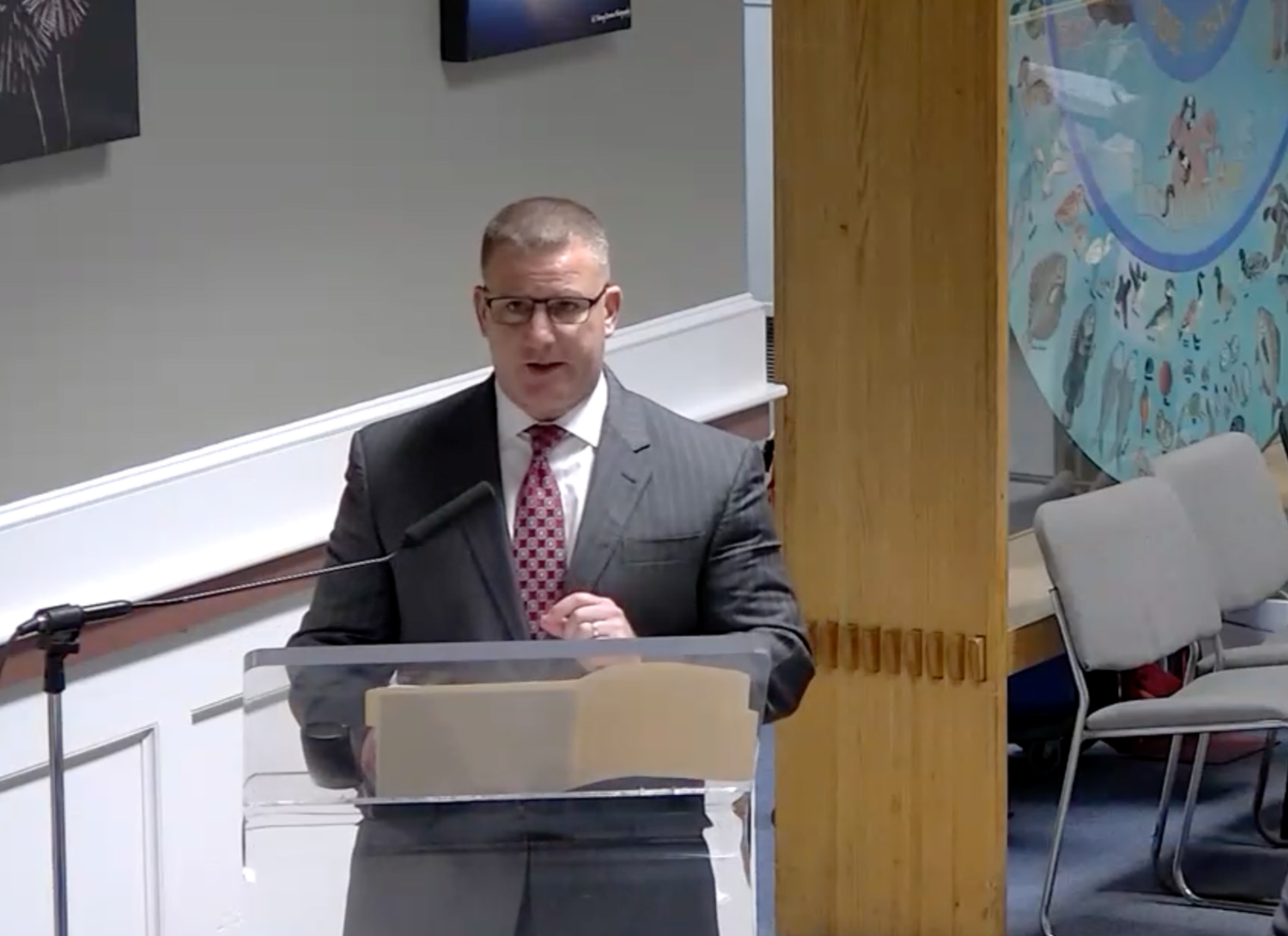
The Wednesday, Nov. 12, town council meeting included one agenda item that inspired a great deal of debate, and was ultimately continued to the Dec. 10 meeting.
Capt. Marc Alboum of the Rhode Island State Police presented RISP’s hope to install a Flock camera in town. (Flock is the company; there’s no further significance to that name).
RISP requires a municipal letter of approval in order to move forward. Alboum said 22 municipalities were approached, 17 provided the letters without further discussion and five, including Bristol, asked Alboum to appear and explain the capabilities of these cameras.
A valuable tool for law enforcement
“Regarding the Flock safety cameras, the Rhode Island State Police are committed to enhancing public safety, eliminating crime and strengthening highway security across multiple jurisdictions throughout the state and the nation,” said Alboum. “Flock safety cameras provide automated vehicle recognition, real-time alerts and advanced analytics. These capabilities significantly aid law enforcement in responding to active threats, for example, mass shootings or any school incidents that happen in the town.”
Alboum noted these cameras also provide real-time updates to help with Amber alerts to help find missing children; Silver alerts to help locate elderly people; and Purple alerts to help locate mental and cognitively disabled adults.
“The flock safety cameras will maximize the ability to collaborate across jurisdictions and responsibly to emerging threats,” said Alboum. “These cameras offer a vital enhancement to our public safety, infrastructure, improving awareness, and investigative outcomes. Their deployment aligns with both technological advancement and operational efficiency, while respecting civil liberties through robust privacy protocols.”
Accordingly, he said these cameras do not utilize facial recognition or speed tracking; they have no public IP so are not accessible remotely to access footage. All data collection points are equipped with secure communication protocols to protect data in transit from interception and tampering. All data is encrypted using industry standard algorithms before being transmitted to the service.
In addition, the Flock cameras are certified by the FBI's Criminal Justice Information Services, they're compliant with the National Defense Authorization Act, the Higher Education Community Vendor Assessment Tool, HIPAA, and Family Educational Rights.
They are also aligned with the security protocols established by the National Institute of Standards and Technology, Cybersecurity, as well as the Cloud Security Alliance's framework.
According to Alboum, the cameras have also provided aid in exonerating suspects.
“These cameras provide a great investigative lead that can fill many gaps within an investigation,” he said. “There are an inordinate amount of testimonials to the positive impact these cameras have had both nationwide and right here in Rhode Island.”
He cited a recent case in Central Falls, where six people were arrested for the murder of the woman who was found in Pawtucket. Flock cameras followed them from Central Falls to the drop site in Pawtucket and back to Central Falls for an easy outcome in that investigation.
Closer to home, Middletown PD recently used Flock kits to obtain a vehicle that was shown to a juvenile victim of sexual assault, and who had positively identified the suspect, who was convicted. Flock cameras located a vehicle stolen from Newport in New Jersey, and Providence PD identified the driver in a fatal hit-and-run motor vehicle accident in October 2023. There are many other examples of their efficacy.
An infringement of privacy rights
On the other hand, opponents, spearheaded by the Rhode Island chapter of the American Civil Liberties Union (ACLU), claim the actual capabilities of these cameras have been severely underplayed by police representatives.
They assert the surveillance system allows police to search by “vehicle type, make, color, license plate state, missing/covered plates, and other unique features like bumper stickers, decals, and roof racks.”
They also claim that every police department that is part of the Flock Safety system has access to the data collected by other agencies, raising the opportunity for targeted and widespread surveillance.
According to the ACLU, police can input any license plate number or vehicle characteristic into the system and pull out any information about that vehicle’s movements over a lengthy period of time in any community where the cameras are being used.
Capt. Alboum disputes that, noting that data collected is automatically deleted after 30 days.
The ACLU is also concerned about abilities, highlighted on Flock Safety’s website, to search by “audio evidence” and “contextual evidence,” which includes “screeching tires” and “associated vehicles,” implying that these systems capture audio in addition to video and utilize artificial intelligence to determine which vehicles in a certain area may be linked to one another.
“Both of these uses, beyond the already invasive capabilities of the video capturing, signify a profound overreach of this technology and invite over-policing and misuse,” according to the ACLU.
Additional concerns cited include collecting interstate travel data in the wake of the overturning of Roe v. Wade; a lack of legislation regulating the scope of this technology; the history of surveillance in the United States used disproportionally in communities of color, as when municipal law departments were found to have used surveillance camera footage to inappropriately monitor activists during the Black Lives Matter protests of summer 2020.
Chief supports the cameras
Locally, Bristol PD Chief Kevin Lynch is a proponent of the cameras and dispelled the notion they are used for anything other than a tool for his officers to perform their duties appropriately.
“There is a common push by people that are trying to stop the Flock camera system, that it's going to be being used for nefarious reasons,” said Lynch. “But I can assure you, we've met with Locke from the Police Chiefs Association, we've discussed these very concerns that we want them to stay specific to what they're designed to do — to read a license plate of a bad actor, or help a missing person, a silver alert, an abducted child, a suicidal person.
“As your police chief for the past seven years, I have safeguarded our residents' civil rights. Everybody has been treated ethically, professionally, and with empathy….There is nothing nefarious behind Flock.”
Council’s response mixed
Concerns about how the cameras might be used in the future, how that information might be shared and retained made it clear that the council was not going to buy into this without a clear written policy and a Memorandum of Understanding (MOU) outlining how the technology would be used.
A motion passed unanimously to continue the matter until the December 10 meeting, when councilors will have a written policy and MOU from the state police.
Keywords
Flock cameras, Rhode Island State Police


