
Shell yeah! Diggers discover the joy of clamming
DEM leads hands-on class to more than 50 people at Gull Gove, Portsmouth
There were plenty of sandy toes and salty-sweet treasures when more than 50 mostly newbies tried their hand at clamming last Friday off Gull Cove Beach.
This item is available in full to subscribers.
Please log in to continue |
Register to post eventsIf you'd like to post an event to our calendar, you can create a free account by clicking here. Note that free accounts do not have access to our subscriber-only content. |
Day pass subscribers
Are you a day pass subscriber who needs to log in? Click here to continue.
Shell yeah! Diggers discover the joy of clamming
DEM leads hands-on class to more than 50 people at Gull Gove, Portsmouth
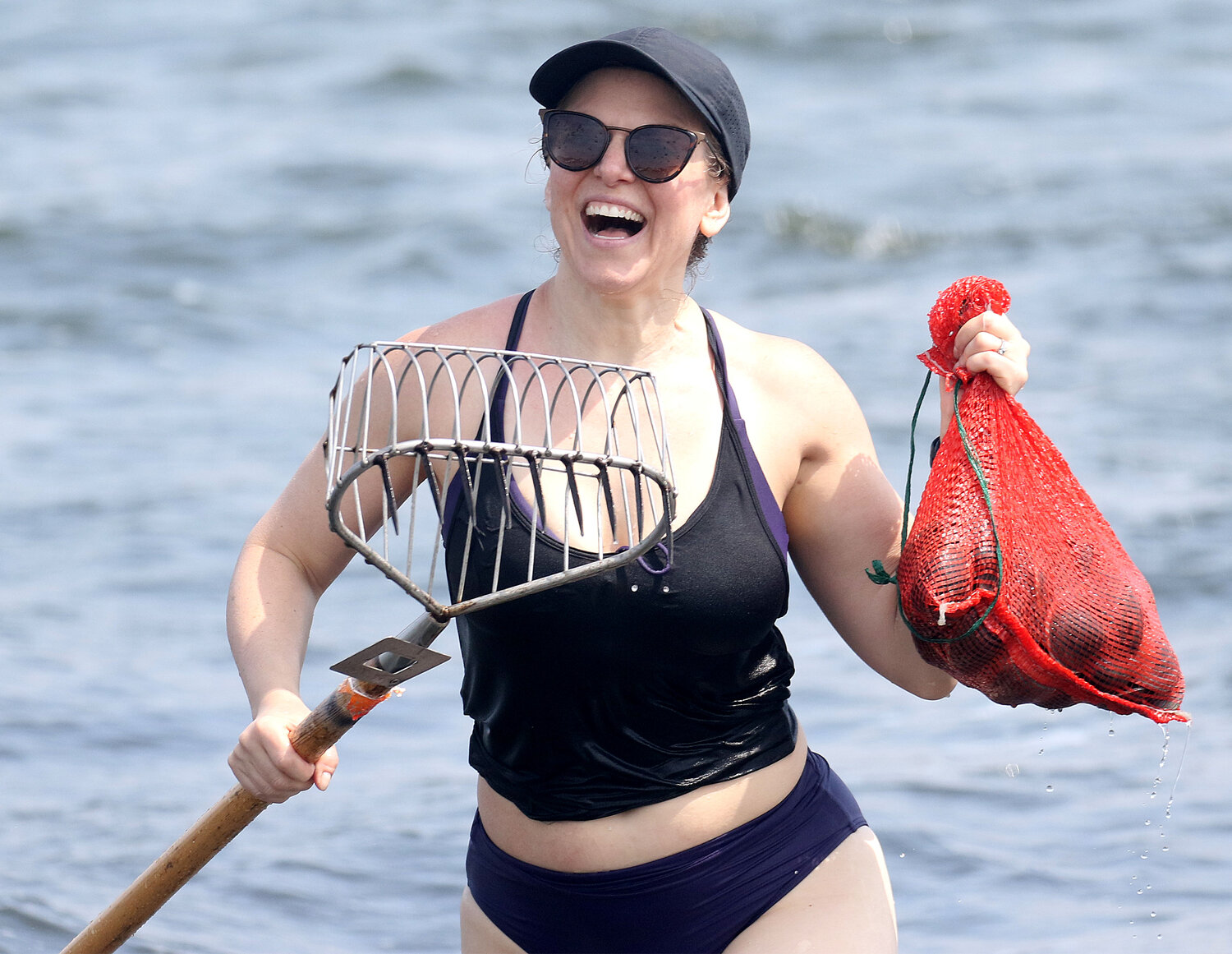

PORTSMOUTH — There were plenty of sandy toes and salty-sweet treasures when more than 50 mostly newbies tried their hand at clamming last Friday off Gull Cove Beach.
The occasion? A sold-out “Come Clam with Me” class run by the R.I. Department of Environmental Management (RIDEM).
“It’s a great family event and an excellent way to connect people with their resources,” said Kimberly Sullivan, a principal biologist with RIDEM who runs the aquatic resource education program in both freshwater and saltwater environments.

The program used to be under the auspices of Rhode Island Sea Grant before RIDEM took it over 11 years ago. The program is open to all ages and costs $10 per person (free for kids under 8).
“They’re coming from all over — Massachusetts, Connecticut,” she said. “Also, a lot of people are vacationing here in the Portsmouth/Bristol area. This is the second year we’ve held it in this area, and it’s one of the most popular spots. It filled up very quickly. It’s a very popular program and there’s always a wait list.”
Quahog King

“I don’t look like this because I play. I look like this because I work,” King said after tossing his own haul on top of a table set up near a RIDEM tent. It took a few minutes, since King had stuffed the six deep pockets on his shorts full of quahogs — about 100 in all.
“I wore a belt today, which was smart,” quipped King, who said he usually averages about 200 quahogs after an hour of digging. “My wife is actually making me a bib — a clam bib.”
Class participants didn’t do nearly as well, of course, but they managed to take some hard shells home after learning the proper technique from King.

“I think we got about 30 quahogs and then a big whelk,” said Gibel. “It took a fair amount of muscle power, but I stood as close to Jody as I could just to figure out the technique. If you kind of wiggle your rake around and then just drag it toward you and scoop, there’s a way to do it that’s not that tough.”
Although you can dig for clams with your bare hands, everyone in the RIDEM class got to borrow a “jerk rake,” a sharp-toothed rake with a bucket at the end. They also were lent metal, rectangular quahog gauges to wear around their necks. Those were to make sure the caught clams were of legal size; in Rhode Island, quahogs must be at least one inch in thickness at the hinge. Anything smaller must be returned to the water.
Another tool of the trade is a toilet plunger, which can soften up the bottom to make finding quahogs and soft-shell clams easier. “There are all different ways; it’s really personal preference,” said Sullivan.
Some tossed back
While Gibel got to keep her whelk, there were other finds besides quahogs that were tossed back on Friday.

Gene Salvatore, a 72-year-old from Connecticut who has a summer home in Portsmouth, emerged from the water with about 10 quahogs. Wearing a “Eat Wicked Local” shirt from Young Farm in Little Compton, he said he wasn’t new to clamming but was curious about the class.
“I just like the area. I like to clam, so I wanted to learn as much as I could about it. It’s great for people to learn about this, and I picked up a few things,” said Salvatore. “I learned how to tell the age of a clam. You count the number of rings and divide by four.”
Another fun fact: A quahog moves only about six feet in its entire life. “Unless we pick it up because it’s too small and throw it back,” said King.
Aw, shucks

“Everybody else on the water that digs is getting 23 to 27 cents for this size,” he said. “But because they’re Jody King clams and not just quahogs, I get 34. When the price drops, my price never drops.”
Opening a clam might seem daunting — heck, dangerous even — to many people, but King made it look easy with his small shucking knife. “I do these from back door — I go through the hinge. All I do is wiggle,” he said, as he opened one up and then cut the meat clean from the shell.

“Coming straight out of the bay — there’s nothing better than that,” King added.
Gibel, who’s originally from New Mexico and had never gone clamming until Friday, kept making return trips to the table behind King to grab another littleneck. “They were delicious,” she said, adding she and her husband had plans for their catch later that night. “I think we’re just going to sit on our porch and shuck ’em.”

“Somebody may ask me, ‘Well, how much of each?’ It’s not how much of each, it’s how much you love. If you love crushed red pepper, you add a lot. If you love garlic, you add a lot. If you love basil and pick it in the garden, add a lot,” said King.
As for Salvatore’s favorite way to prepare quahogs? “I throw them right on the grill, let them open up, get a little butter and lemon and just dip ’em right in,” he said.
Rotate digging spots
Sullivan noted that Rhode Island residents do not need a license to go clamming.
“As a resident you can get up to a peck of clams a day per person. That’s about two gallons of clams. They’re able to take whatever they catch as long as it’s within those parameters,” she said.

“We have anywhere from five to six classes per season, and we rotate locations,” she said. “We have a couple over at Rocky Point in Warwick, a couple over at North Kingstown Town Beach, and here we only have two.”
Teaching people how to find safe spots for quahog harvesting is part of the class, Sullivan said. And if Jody King’s not around, you can still learn from the masters.
“Stay on the rocks, and if you come down here watch the old men,” he said. “I’m not kidding. There’s four or five old guys who come here on a regular basis. If they’re here, they’re not here to catch nothing.”

Keywords
RIDEM, quahogs, clamming, Gull Cove


